A center-scale approach
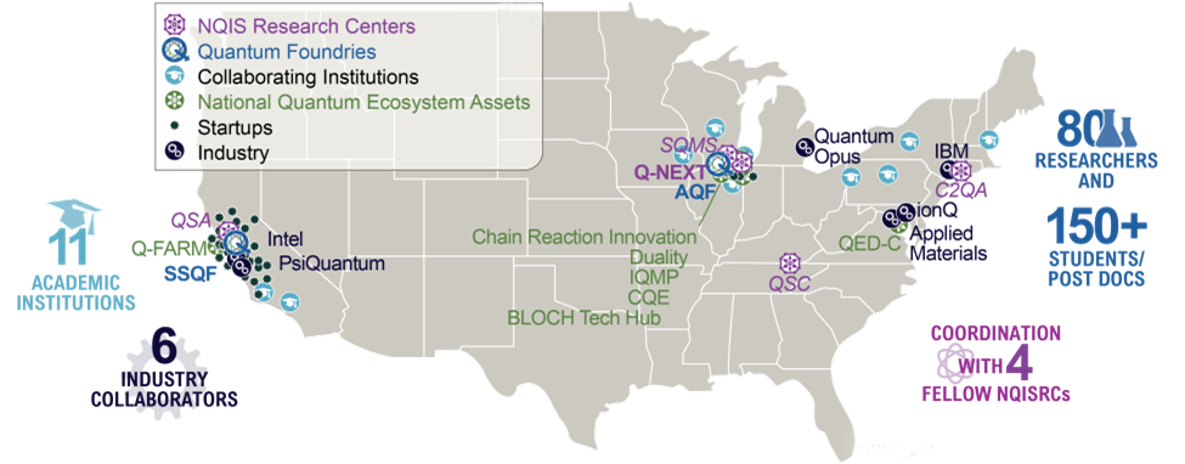
Q-NEXT brings together 80 leading quantum information researchers from 19 organizations, uniting national laboratory capabilities and academic discovery with industry to deliver use-inspired science.
Through its center-scale approach, Q-NEXT produces focused work while ensuring agility across the collaboration. The national labs’ embedded research facilities enable tight feedback between researchers. Universities generate discoveries that government and industry put to use. And industry engagement at every level of Q-NEXT ensures the two-way transfer of technological advances.
Quantum problems are diverse and multifaceted, and it takes an equally diverse set of researchers and facilities to tackle them. Q-NEXT members are leaders in the physics and chemistry of quantum systems, materials processing and device design, quantum simulations and architectures, and algorithms and programming. The center’s research spans fundamental science, devices, systems, prototypes, and applications.
By uniting collaborators in diverse disciplines under one umbrella, Q-NEXT fosters a fruitful environment for advancing quantum information science and creates bridges between sectors, providing each with resources and capabilities that would not be otherwise available.
Continual cooperation between individuals and between industry, academic and government partners ensures steady technology advances and promotes connectivity across the collaboration, enhancing U.S. competitiveness by accelerating technology commercialization for the emerging quantum economy.