 Core binding energy calculations: a scalable approach with the quantum embedding-based equation-of-motion coupled-cluster method
Journal of Physical Chemistry Letters (2024)
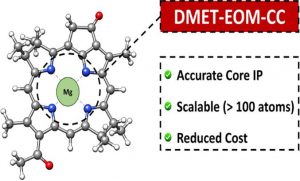
In this paper, scientists present a quantum method to efficiently compute the core ionization energies of large molecules. They combined their method, called EOM-CCSD*, with the core-valence separation (CVS) approximation to target core-level properties. Then they integrated this method with density matrix embedding theory to reduce scaling and computational costs.
Without embedding, this method produced core ionization potentials (IPs) very close to experimental values, with an average deviation of about 0.5 eV from experimental values (in the order of a few hundred eV) for a specific set of data. The embedded method introduced only a small additional error — about 0.07 eV on average — while significantly speeding up the calculations.
By using the embedded version, they could compute the core ionization energies of complex molecules such as the uracil hexamer, doped fullerene, and chlorophyll using very large basis sets (up to around 4000 functions) and still stay within 1 eV of experimental values. Such large-scale calculations with high-level methods like EOM-CCSD* are not feasible with the unembedded method.
This work will pave the way for the development and characterization of the novel spin-defect qubits.
The authors are Bhavnesh Jangid, Matthew Hermes and Laura Gagliardi, conducting work at the University of Chicago.