
Entangling particles with optomechanical crystals

High photon-phonon pair generation rate in a two-dimensional optomechanical crystal

Nature Communications (2025)


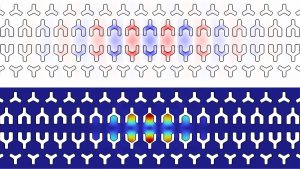
A team of researchers worked on tiny devices that use light and vibrations to process and transfer quantum information. However, these devices often overheat, which limits their performance.

The team designed a new type of structure — a two-dimensional optomechanical crystal (OMC) — that cools down much better than previous designs. The new OMC has a vibration mode at 7.4 GHz, making it a good match for existing quantum hardware.

The study shows that the device has strong interactions between light and vibrations, stays cool more effectively and maintains high optical quality. This allows it to reach an extremely low-energy state, close to the absolute quantum ground state, while maintaining low temperatures. It also produces entangled pairs of light and sound particles, which could be useful for future quantum technologies.

The breakthrough could help create better connections between microwave-based quantum computers and optical communication networks, improving the way quantum information is shared and processed.

The paper’s authors are Felix Mayor, Sultan M., André Garcia Primo, Samuel Gyger, Wentao Jiang, Thiago Alegre and Amir Safavi-Naeini, conducting work at Stanford University and the Universidade Estadual de Campinas.

News and features

See all news and features
  • David Awschalom wins global Breakthrough of the Year award

    David Awschalom, Q-NEXT Chief Science Officer and the Liew Family Professor of Quantum Engineering and Physics at the University of Chicago, received the prestigious Falling Walls Science Breakthrough of the Year in Physical Sciences for a pioneering body of work that broke the wall between quantum technology, molecules, and proteins. Read More

  • Helium lifts new quantum computing concept

    A team led by Jacob Covey, who is part of Q-NEXT and is an Associate Professor at the University of Chicago, laid out a new concept that could turn helium’s light weight into the next generation of quantum computers. The design relies on helium-3, an isotope with different quantum properties than the helium-4 used to cool MRI machines and fill party balloons. Once built, the computer could use high-powered lasers as “optical tweezers” to capture and control individual atoms of helium. Read More

  • Researchers make materials that support quantum technology

    Researchers from the University of Illinois Urbana-Champaign who are part of Q-NEXT are engineering material systems that support quantum technology. Chris Anderson and his team are developing materials for quantum transduction — the conversion of quantum information from one form to another. Elizabeth Goldschmidt, Daniel Shoemaker, and colleagues are developing quantum memory technology that stores quantum information for extended periods of time. Read More

  • Q-NEXT-developed open-source software receives 2026 R&D 100 award

    SeQUeNCe, a free, open-source software developed by Argonne scientists with Q-NEXT support, is one of seven Argonne projects that received a 2026 R&D 100 Award. The SeQUeNCe software lets researchers test how quantum networks might work before building them. Read More

  • Researchers generate spontaneous magnons that synchronize with external signals

    Researchers at Argonne and the University of Illinois Urbana-Champaign demonstrate a method for generating stable ripples in magnetic materials called magnons. The work opens avenues for information processing in microelectronics and quantum devices. Read More