by Jennifer Dionne
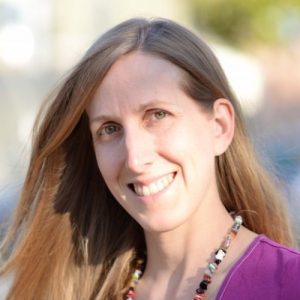 For the last two-and-a-half years, I’ve been privileged to serve as the lead for Q-NEXT’s Extreme Scale Characterization thrust. Together, the ESC team — composed of colleagues across two national labs and several universities — have worked to identify qubit structure, dynamics, and sources of decoherence from the qubit to the system level.
Now I’m pleased to say that, in late May, I stepped into the role of Q-NEXT deputy director, another wonderful opportunity. I succeeed JoAnne Hewett, who was an incredible leader. I know I have big shoes to fill! Brookhaven is very lucky to have her. With JoAnne at Brookhaven’s helm, David Awschalom leading the way at Q-NEXT, and Supratik Guha as our esteemed CTO, we will seek opportunities to strengthen the collaboration between Q-NEXT and our sister center at Brookhaven, the Co-design Center for Quantum Advantage.
With this new role, I’m stepping down as ESC thrust lead. I’m delighted to share that Martin Holt of Argonne has agreed to take on this role. Martin has been serving as ESC deputy lead and has been an outstanding partner and colleague in ESC. And stepping into the role of ESC deputy lead is my Stanford and SLAC colleague Aaron Lindenberg, another wonderful collaborator. Thank you, Martin and Aaron.
As Q-NEXT deputy director, I’m excited to work with an incredible team of quantum scientists. My involvement with Q-NEXT so far has reaffirmed how mysterious, wondrous and impactful quantum systems can be. With advances in materials synthesis, assembly and characterization, Q-NEXT researchers are making significant strides in improving qubits, quantum sources, modulators, memory and quantum interconnects.
I’m excited to help grow the research infrastructure needed to make large-scale quantum information systems practical. Incredible scientific instrumentation is now coming online at Argonne, especially at the Argonne Quantum Foundry; at SLAC, with its upcoming Detector Microfabrication Facility, the LCLS-II accelerator, and its Megaelectronvolt Ultrafast Electron Diffraction Instrument; and at Stanford, especially as part of its Shared Facilities Initiatives. (In 2022, Stanford announced an approximately $20 million investment in shared facilities and data resources. This year, another roughly $40 million is being invested.) These capabilities will help unravel as yet unknown and unexplored properties of solid-state, molecular and superconducting quantum systems across length and time scales.
I’m also looking forward to helping bolster the already impressive collaborations Q-NEXT has with industry. In a field like QIS, strong connections between fundamental science and translational work are critical to accelerate progress.
Those who know me know I’m passionate about bringing up the next generation of scientists, and so I’m especially excited to look for new ways to advance the education of future quantum researchers as Q-NEXT deputy director. Q-NEXT students and postdocs are some of the most talented researchers I have had the pleasure of working with, and the future is bright with them charting a path toward novel quantum systems.
Finally, I feel very grateful to work alongside amazing staff at Q-NEXT. Phil Smith, Betsy O’Connor, Charlotte Holloway and Leah Hesla are not only inspiring and fun, but ensure any uncertainty is at the Heisenberg limit.
Jennifer Dionne is the Q-NEXT deputy director.
This work was supported by the DOE Office of Science National Quantum Information Science Research Centers.